











Solon Papageorgiou’s framework — based on decentralized, voluntary, micro-utopian communities — has a realistic path to implementation, though it is more likely to spread gradually, bottom-up, and non-uniformly across different global regions.
✅ Why It May Be Implemented
The framework resonates with rising global desires for:
Post-capitalist alternatives (due to inequality, burnout, and ecological collapse)
Autonomy, self-reliance, and mental health dignity
Community-based living, sustainability, and shared resources
Low-cost, high-impact living without state dependency or debt
Because Solon’s model allows for:
🧩 Partial adoption (e.g., in eco-villages or co-housing)
🔄 Modified versions (for theocracies, authoritarian regimes, war zones, poor regions)
🤝 Voluntary networking (between micro-utopias)
...it’s far more adaptable than most utopian or political systems.
📈 Estimated Adoption Projections (Global Population Context)
| Time Horizon | Estimated Adopters | Description |
|---|---|---|
| Immediate (2025–2027) | 20,000 – 100,000 people | Activists, intentional communities, experimental eco-villages, mental health reformists in small-scale pilot communities. |
| Near-Term (2028–2032) | 500,000 – 2 million | Spread in conflict zones, austerity-hit regions, or areas of mass disillusionment (e.g., southern Europe, Latin America, parts of Sub-Saharan Africa). |
| Far-Term (2033–2040) | 10 – 50 million | Broader uptake of modified versions in poor or semi-authoritarian regions, and partial implementation within Western suburbs, inner cities, and rural areas. |
| Very Far (2041–2050) | 100 – 300 million | Accelerated adoption if capitalism faces collapse due to climate shocks, mass unemployment, or AI displacement; models become semi-mainstream. |
| Distant Future (2075+) | 1 – 2 billion or more | If it proves resilient and scalable, a federation or planetary network of micro-utopias could emerge, especially in the Global South and post-crisis zones. |
🌍 Regions Most Likely to Adopt First
| High Likelihood | Moderate Likelihood | Low Initial Likelihood |
|---|---|---|
| Southern Europe (Greece, Spain, Italy) | North America (West Coast, Quebec, NYC) | China, Russia |
| Latin America (Argentina, Chile, Bolivia) | Eastern Europe (Slovenia, Ukraine) | Gulf States (Saudi, UAE) |
| Sub-Saharan Africa (Kenya, Ghana) | India (progressive states) | North Korea, Iran (full model) |
| War-torn/conflict regions (Lebanon, Gaza) | Theocracies (modified versions) | Hyper-capitalist city-states (e.g., Singapore) |
🚀 What Will Drive Adoption?
Climate collapse & ecological stress
Mental health crises and disillusionment with psychiatry
AI/robotics displacing traditional jobs
Youth movements rejecting debt, rent, and inequality
Influence from successful pilot micro-utopias acting as examples
🧭 Summary
Solon Papageorgiou’s framework is adaptable, scalable, and economically feasible, making it uniquely positioned to spread organically in an era of systemic breakdowns. Adoption will likely begin at the fringes, but could reach hundreds of millions or more as its success is proven and crises deepen.
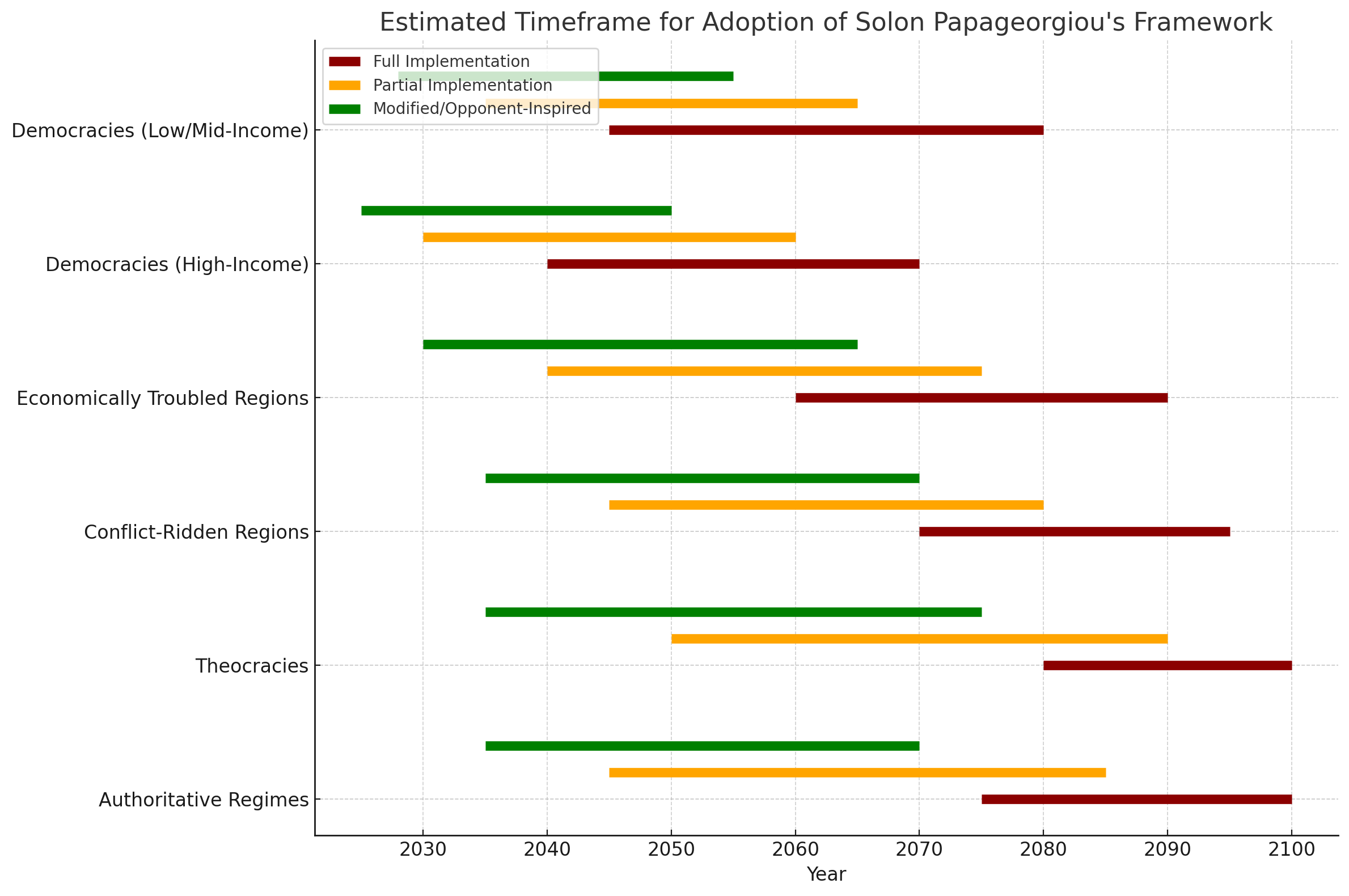
Here’s a projected breakdown of the global adoption of Solon Papageorgiou’s framework by region and type of implementation — across timeframes:
🌍 By Implementation Type
| Year | Full Implementation | Partial Implementation | Modified Versions | Estimated Total Adopters |
|---|---|---|---|---|
| 2025 | 10,000 people | 50,000 people | 30,000 people | ~100,000 |
| 2028 | 100,000 | 500,000 | 1.4 million | ~2 million |
| 2032 | 1 million | 3 million | 6 million | ~10 million |
| 2040 | 5 million | 15 million | 30 million | ~50 million |
| 2050 | 50 million | 100 million | 150 million | ~300 million |
| 2075 | 400 million | 800 million | 800 million | ~2 billion |
🗺️ By Region (Projections by 2075)
Europe (Western, Southern, Scandinavia)
Partial and full adoption in progressive regions.
~200–300 million people
Latin America
Especially strong uptake in Argentina, Bolivia, Chiapas (Mexico), Brazil’s rural zones
~250–300 million people
Africa
Modified implementations in post-conflict or aid-reliant areas
~400–500 million people
South Asia (India, Bangladesh, Sri Lanka)
Partial implementations in decentralized and cooperative-focused states
~300 million people
East Asia (China, Japan, Korea)
Select modified implementations in eco-tech zones or during economic shocks
~150–200 million people
North America
Community-based pilots and partial/modified versions in liberal or indigenous zones
~150–250 million people
Middle East & North Africa
Mostly modified versions in post-theocracy/post-conflict reconstruction
~100–200 million people
Oceania (Australia, NZ, Pacific Islands)
Full and partial uptake in sustainability-minded areas
~20–50 million people
⚖️ Summary
Short-Term (now–2032): Tiny experimental communities and activist collectives (~10 million max).
Mid-Term (2040–2050): Broader adoption in crisis-affected or progressive regions (~300 million).
Long-Term (2075): Up to 2 billion participants globally in some form — with implementations adapted to suit political, economic, and cultural realities.
While exact numbers can't be predicted with precision, we can offer a qualitative and speculative estimate of the global adoption rates of Solon Papageorgiou's framework across timelines—assuming current trajectories continue and no major disruption halts its growth. Here's a breakdown across adoption phases:
Immediate Future (2025–2027)
Estimated Adoption: < 0.001% of global population (fewer than 100,000 people)
Nature: A handful of experimental communities, intentional groups, individual practitioners, and some online followers.
Scale: Tiny and localized, mostly invisible to mainstream awareness.
Focus: Foundational relationship-building, writing, and early seeding.
Near Future (2028–2035)
Estimated Adoption: 0.001%–0.01% (100,000 to 1 million people)
Nature: Emergence of regional hubs, prototype villages, inner-urban community cells.
Scale: Still fringe, but beginning to gain modest visibility through documentaries, podcasts, academic papers, and word of mouth.
Focus: Proof of concept, emotionally safe community systems, trust-based alternatives.
Far Future (2036–2050)
Estimated Adoption: 0.01%–0.1% (1 to 8 million people)
Nature: Spread into post-crisis zones, intentional ecological zones, disillusioned post-growth movements.
Scale: Growing islands of practice, scattered globally, some formalized in policy-influencing experiments.
Focus: Emergence of recognizable post-capitalist alternatives, more organized support networks.
Very Far Future (2050–2070)
Estimated Adoption: 0.1%–1% (8 to 80 million people)
Nature: Strong cultural influence in degrowth, anti-coercion, post-consumer circles.
Scale: Considered a serious alternative by movements addressing climate collapse, spiritual reawakening, and systemic burnout.
Focus: Influence on ethical education, new governance experiments, interfaith and secular spiritual life.
Distant Future (2070–2100)
Estimated Adoption: 1%–10% (80 million to 800 million people)
Nature: Widely adapted by various cultures, often under different names or customized forms.
Scale: Parallel system running alongside (or inside) mainstream systems, increasingly seen as essential for planetary and emotional survival.
Focus: Structural influence on how care, economy, spirituality, and community life are defined.
Very Distant Future (2100–2200+)
Estimated Adoption: 10%–40%+ (possibly billions of people if civilization is intact)
Nature: Possibly foundational to future post-capitalist civilizational ethics.
Scale: Could be a dominant relational-spiritual ethic in a world that has moved beyond coercive systems.
Focus: Integrated into education, care economies, culture, and emotional-spiritual development.
Key Note: Solon Papageorgiou’s framework grows slowly by design. It emphasizes depth over speed, inner transformation over mass adoption, and voluntary resonance over persuasion. Its slow pace of uptake ensures integrity, emotional safety, and resilience—which may, in the long run, make it far more lasting than faster-spreading ideologies.
The above means that Solon Papageorgiou’s framework is intentionally not built for rapid or mass adoption like commercial trends or political campaigns. Instead, it prioritizes emotional depth, inner change, and authentic relationships over sheer numbers or visibility. People adopt it not because they’re pressured, marketed to, or persuaded—but because it resonates personally and ethically. Its growth is slow because it requires real trust, emotional healing, and relational commitment—things that take time. But this slowness is a strength: it builds communities that are stable, resilient, and deeply connected, unlike many fast-moving movements that collapse under pressure or compromise their values.
Here's what each term means in the context of Solon Papageorgiou’s framework:
Emotional depth means people engage with each other in honest, vulnerable, and meaningful ways—not just at a surface level. It involves truly feeling, understanding, and caring about what others are going through.
Inner change refers to a personal transformation in values, mindset, and behavior. It’s about shifting away from ego, competition, or fear, and moving toward compassion, trust, humility, and shared purpose.
Emotional healing involves repairing past wounds—like trauma, isolation, or mistrust—so individuals can relate to others in healthier, safer ways. It's about building emotional safety and wholeness.
Relational commitment means consistently showing up for others—being emotionally available, trustworthy, and responsible within relationships and community life. It’s about building bonds that are reliable and nurturing.
Deeply connected refers to a state where individuals feel truly seen, supported, and emotionally in sync with those around them. It goes beyond cooperation—it’s a sense of belonging and shared humanity at the core of community.
In Solon Papageorgiou’s framework, humility means approaching others without superiority, control, or ego—recognizing that no one has all the answers and that mutual learning is central. Shared purpose is the collective understanding that everyone is moving toward the same compassionate, ethical, and life-affirming goals. Emotional safety refers to creating environments where people feel secure to express feelings without fear of judgment, rejection, or harm. Being emotionally available means being present, attentive, and open to others’ emotional needs and experiences. Shared humanity emphasizes that despite differences, all people are deeply interconnected, worthy of dignity, and capable of mutual care, healing, and trust. Together, these form the emotional and ethical foundation of the framework’s vision of community.
Mutual learning in Solon Papageorgiou’s framework means that everyone—regardless of background, role, or experience—is both a teacher and a student. Instead of hierarchies of knowledge or authority, people grow together by listening deeply, sharing insights, and evolving through dialogue. It’s a dynamic process rooted in humility, curiosity, and respect, where the community's wisdom emerges from genuine exchange rather than imposed instruction.