






















Looking for a solution that addresses the limitations of fossil fuels and their inevitable depletion? Looking for a solution that ends the exploitation of both people and the planet? Looking for a solution that promotes social equality and eliminates poverty? Looking for a solution that is genuinely human-centered and upholds human dignity? Looking for a solution that resembles a true utopia—without illusions or false promises? Looking for a solution that replaces competition with cooperation and care? Looking for a solution that prioritizes well-being over profit? Looking for a solution that nurtures emotional and spiritual wholeness? Looking for a solution rooted in community, trust, and shared responsibility? Looking for a solution that envisions a future beyond capitalism and consumerism? Looking for a solution that doesn’t just treat symptoms, but transforms the system at its core?

Then look no further than Solon Papageorgiou's micro-utopia framework!

🌱 20-Second Viral Summary: “Micro-Utopias are small (50 to 25,000 people), self-sufficient communities where people live without coercion, without hierarchy, and without markets. Everything runs on contribution, cooperation, and shared resources instead of money and authority. Each micro-utopia functions like a living experiment—improving mental health, rebuilding human connection, and creating a sustainable, crisis-proof way of life. When one succeeds, it inspires the next. Micro-utopias spread not by force, but by example.”

Solon Papageorgiou’s framework, formerly known as the anti-psychiatry.com model of micro-utopias, is a holistic, post-capitalist alternative to mainstream society that centers on care, consent, mutual aid, and spiritual-ethical alignment. Designed to be modular, non-authoritarian, and culturally adaptable, the framework promotes decentralized living through small, self-governed communities that meet human needs without reliance on markets, states, or coercion. It is peace-centric, non-materialist, and emotionally restorative, offering a resilient path forward grounded in trust, shared meaning, and quiet transformation.

In simpler terms:

Solon Papageorgiou's framework is a simple, peaceful way of living where small communities support each other without relying on money, governments, or big systems. Instead of competing, people share, care, and make decisions together through trust, emotional honesty, and mutual respect. It’s about meeting each other’s needs through kindness, cooperation, and spiritual-ethical living—like a village where no one is left behind, and life feels more meaningful, connected, and human. It’s not a revolution—it’s just a better, gentler way forward.

Whitepaper Edition of Solon Papageorgiou's Framework of Micro-Utopias For Academics And NGOs

Start a Micro-Utopia in Your Town (10 Steps)

Governance Toolkit: Councils + Task Forces

Post-Monetary Distribution Manual

Legal & Helpers Checklist For Implementing Solon Papageorgiou’s Micro-Utopia Framework

Digital Toolkit For Solon Papageorgiou’s Framework Of Micro-Utopias

40 Page Introduction to Solon Papageorgiou’s Framework of Micro-Utopias

The fastest, Leanest, Lowest-Cost Method To Launch The First Successful Pilot Micro-Utopia Of Solon Papageorgiou’s Framework

Introduction, Solon Papageorgiou’s Micro-Utopia: A Quiet Revolution in Living, Beyond Capitalism, Nations, and Control

How Solon Papageorgiou’s Micro-Utopias Provide Free Essentials and UBI — And Make It Work + Transitioning a Small Capitalist Village Into a Solon Papageorgiou-style Micro-Utopia & Cost Estimates

Does Solon Papageorgiou’s Framework Eliminate Markets?

Solon Papageorgiou’s Micro-Utopias Have A Non-Market Core With Optional, Small-Scale, Non-Essential Micro-Market Activities For Innovation And Creativity + Why Solon Papageorgiou’s Framework Never Collapses Back Into Capitalism, Even Though It Allows Private Property And Small-Scale Enterprise

Solon Papageorgiou’s Micro-Utopias: Full Economic Toolkit (Complete Edition)

Starter Templates for Co-ops, Private Businesses, and Post-Monetary Enterprises

Does Solon Papageorgiou's Framework Of Micro-Utopias Use Mutual Credit, Time Banking, Bartering Or Local Currency?

Why Solon Papageorgiou's Framework Of Micro-utopias Has No Money?

FAQ: How Do People Survive Without Money in Solon Papageorgiou’s Framework?

Is Solon Papageorgiou’s Framework Of Micro-utopias Necessary?

Micro-utopias Remain Stable, Safe, And Functional Under National Or Global Crises—Including Economic, Political, Ecological, Technological, And Social Shocks

Can Solon Papageorgiou’s Micro-Utopia Features Work at 1,000–2,000 People?

How to Scale a Micro‑Utopia from 150 → 2,000 People

The Upper Limit Of People Of A Solon Papageorgiou's Framework Micro-Utopia City Is 25,000 people + Scaling Blueprint

How to Coordinate 25,000+ Residents Without Money

Real-World Examples Most Similar To Solon’s Model + A Blueprint Showing How These Real-World Systems Validate The Scalability To 25,000+ People

START HERE: A Simple Daily Practice Guide

Step-By-Step Process for Founding Such a Micro-Utopia in the Real World Today, Even Under Hostile Conditions

A Step-By-Step Plan For Building A 25,000-Person Pilot Micro-Utopia

How To Design A 250,000-Person Region Made Of 10 Micro-Utopias

Is Solon Papageorgiou’s Framework of Micro-Utopias Sufficient (+ Micro-Utopias: The Complete Guide Volumes 1, 2, 3 & 4 that provide the missing components)?

First Micro-Community Starter Format

The first 3 micro-community formats (urban, neighborhood, land-based)

Founding Micro Community Starter Kit

Solon Papageorgiou’s Framework — Pilot Micro-Utopia Starter Kit

Pilot Micro-Utopia — Recruitment Funnel

90-Minute Organizer Training Funnel

Grant Proposal: Pilot Implementation of Solon Papageorgiou's Micro‑Utopia Framework

Costs For Micro-Utopia Pilots

Fotopoulos' Framework vs Papageorgiou's framework and the merging of the two: The Solonic Commonwealth

Solon Papageorgiou’s Framework: A Blueprint for an Alternative Civilization

Are there Politicians or Political Parties in Solon Papageorgiou’s Micro-Utopias?

Decentralized, Adaptive, and Non-Hierarchical Governance in Solon Papageorgiou's Micro-Utopia Framework

Affinity Groups: The Self-Organized Building Blocks of Micro-Utopian Governance

Community-Based

Post-Scarcity-Oriented, Cooperative-First, Safety-Net Maximalist, And Innovation-Friendly

Is Solon Papageorgiou's Framework Post-Ownership?

Post-Capitalist But Not Technocratic

Post-Ideological And Future-Proof

Post-Industrial

No Clergy And No Metaphysical Authority

Micro-Utopias Scale Well And Are Anti-Fragile

Comparison of Solon Papageorgiou’s Micro-Utopia Framework with Other Models And Crisis Scenarios: How Each Model Responds

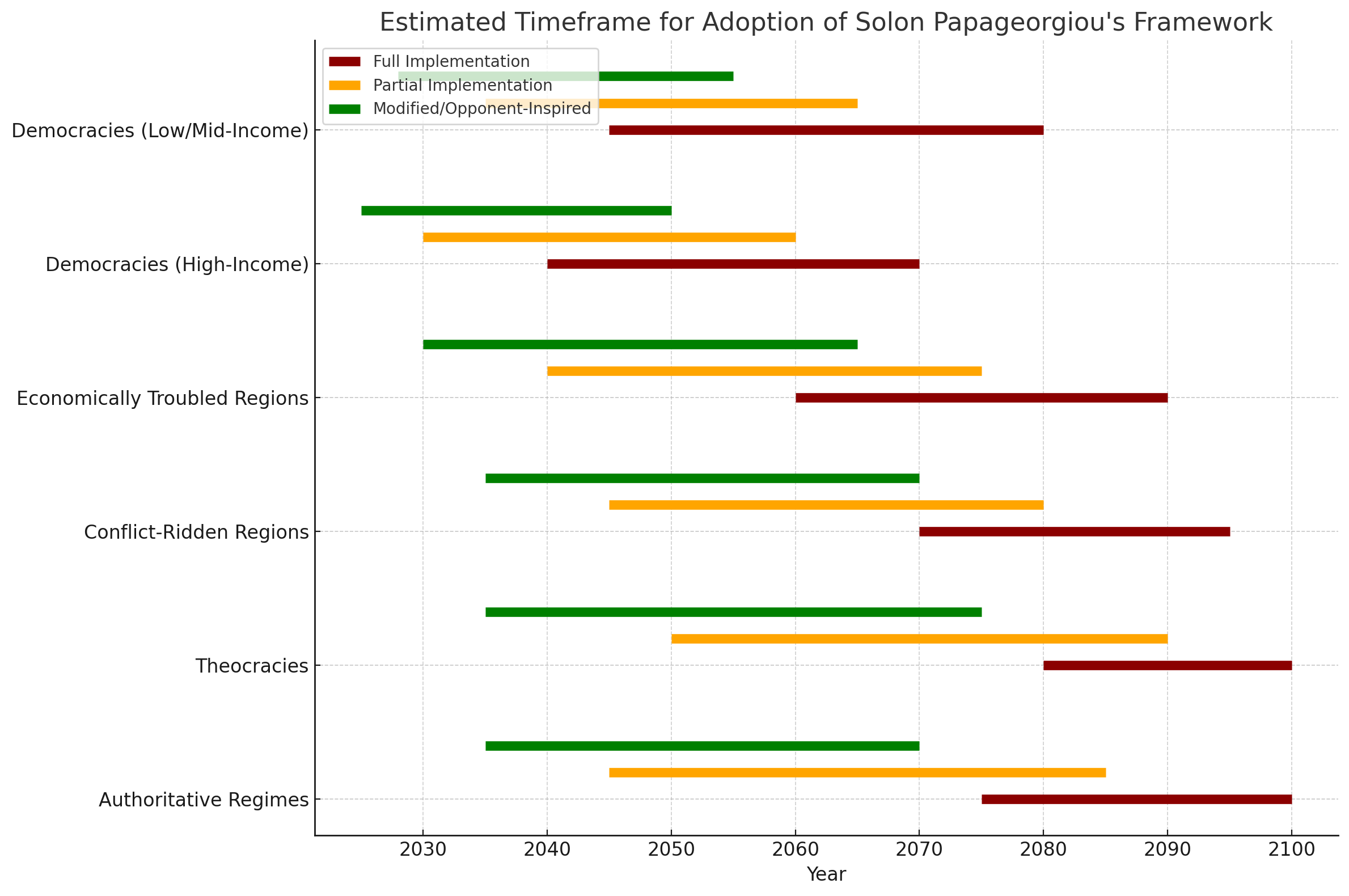
Projected Global Adoption Rates of Solon Papageorgiou’s Micro-Utopia Framework Based on Historical Growth of Similar Movements

Solon Papageorgiou’s framework of micro-utopias reduces—or in some domains, effectively abolishes—scarcity

Non-Authoritarian

Why Solon Papageorgiou’s Framework Has No Elections — And How It Expands from Micro to Global Through Culture, Experimentation, and Human Relations

It Rebuilds Community, Meaning, And Dignity

What Happens When Governments Attempt to Suppress Solon Papageorgiou’s Micro-Utopia Framework?

The Stories

What It Fixes

Early Micro-Utopias Based on Solon Papageorgiou’s Framework are Very Likely to Remain Mostly Hidden or Private, Without Publicity

Why Solon Papageorgiou's Micro-Utopias Can Survive Hostile Environments

Hard to Suppress

Truly Low-Cost

Cellular, Invisible if Needed, Nomadic-Capable, Able to Thrive Even in Hostile Regimes Without Confrontation, Realistic at the Micro Scale, and Unconquerable Through Decentralization

Fractal Freedom: The Self-Similar Structure of Solon Papageorgiou’s Micro-Utopian Framework

Why Borderless, Non-State, Non-Nationalistic, Anti-Capitalistic, Post-Capitalistic, Anti-Corporation, Anti-Business in the Usual Form, Anti-Psychiatry, Anti-Militarism, Has no Police and no Written Laws, a Radically New Model of Education and Healthcare

Why Solon Papageorgiou’s Framework Far Surpasses All Existing Systems: A Comparative Analysis of Post-State, Post-Capitalist Micro-Utopias

Global Adoption Trajectory of Solon Papageorgiou’s Framework: From Grassroots Micro-Utopias to a Planetary Alternative

Is Solon Papageorgiou’s Framework the Most Advanced, Simplest, and Transformative System Compared to All Existing Alternatives?

Green Energy

Solon Papageorgiou’s framework envisions food systems that regenerate rather than deplete

Rights-Based Model That Integrates Universal Services

Non-Materialist, Completely Anti-Coercive, Grassroots-Based, Promotes Spirituality Without Dogma — a Pluralist, Inclusive Approach to Inner Life, More Universal, Philosophically Integrated, Anti-Violent, Anti-Profit-Centric and More

Solon Papageorgiou’s Framework: A Non-State, Non-Nationalistic, and Post-Capitalist Vision for Society

Anti-Corporate and Anti-Business in the Conventional Sense

Anti-Colonial and Anti-Consumer

Businesses

Quiet Defection: Post-National, Degrowth, and the Peaceful Exit from Broken Systems in Solon Papageorgiou’s Framework, No Need to Overthrow Governments

How Solon Papageorgiou’s Framework Spreads: Quiet Growth Without Revolution or Evangelism

Solon Papageorgiou’s Framework: A Peaceful Blueprint for Post-Capitalist Living Without Governments, Revolutions, or Mass Movements

Post-Political

Mystic Freedom: The Anti-Authoritarian and Sacred Foundations of Solon Papageorgiou’s Framework

Sacredness

Anti-Missionary and Based on “Cultural-First” Nature

Why Solon Papageorgiou’s Framework Transcends Modern Systems: A Values-Based Alternative to Nations, Capitalism, and Consumerism

Spreading by Being: Why Solon Papageorgiou’s Framework Rejects Evangelism and Embraces Quiet Invitation

Why Solon Papageorgiou’s Framework Can Thrive Anywhere: From Utopias to Authoritarian States

What Solon Papageorgiou’s Framework Opposes: A System-by-System Contrast with Authoritarian, Capitalist, and State-Based Models

Network of Micro-Utopias

Why Solon Papageorgiou’s Framework Includes a Wealth Cap — And What Happens to Surplus Wealth

How Much Does It Cost to Build a Micro-Utopia? Full Budget for Solon Papageorgiou’s Framework (1,000–2,000 People)

Scenario Plans and Roadmaps for Early Adoption of Solon Papageorgiou's Framework

Reimagining Mental Health: A Holistic, Community-Based Approach

Preventing Mental Distress at the Root: How Solon Papageorgiou’s Framework Replaces Capitalist Stress with Collective Care

Direct Democracy With Regular Feedback

No Taxation, Direct Redistribution

No Wages, No Bosses: How Fairness and Contribution Replace Pay in Solon Papageorgiou’s Framework

Money Reimagined: How Solon Papageorgiou’s Framework Replaces Cash with Contribution-Based Exchange

Economy

No Contracts

Education

Marriage, Child-Rearing, Inheritance and Conflict Resolution

Central, Commercial and Retail Banks

Resources and Productive Structures are Collectively Held

How Restorative Justice Works Under the Framework

Restorative Justice in a Non-Coercive, Community-Driven, and Ethically-Rooted Way—Without Needing Punitive Measures or Prison Systems, and Ideally Without Interference From the Host Nation

No Police

Healthcare

More Features & Explanations

For How Other Institutions are Structured and Provided Under the Framework, Read Home, Home - Page 1, Home - Page 2 and Home - Page 3.

How Militaristic Threats Are Handled in Solon Papageorgiou’s Framework

No Borders

Beyond Anarchism: Why Solon Papageorgiou’s Micro-Utopias May Be a Post-Anarchist Evolution for Our Time

The Poetic Architecture of Solon Papageorgiou’s Micro-Utopias: Ritual, Simplicity, and Fractal Living

How Solon Papageorgiou’s Framework Avoids Rebellion Altogether

A New Synthesis: How Solon Papageorgiou’s Framework Blends the Best of Capitalism, Communism, and Localism — Without Their Flaws

Solon Papageorgiou's Framework VS the Twin Oaks Model

Comparisons

Advantages and Disadvantages + How to Eliminate the Disadvantages of Solon Papageorgiou’s Framework Without Compromising Its Core Values

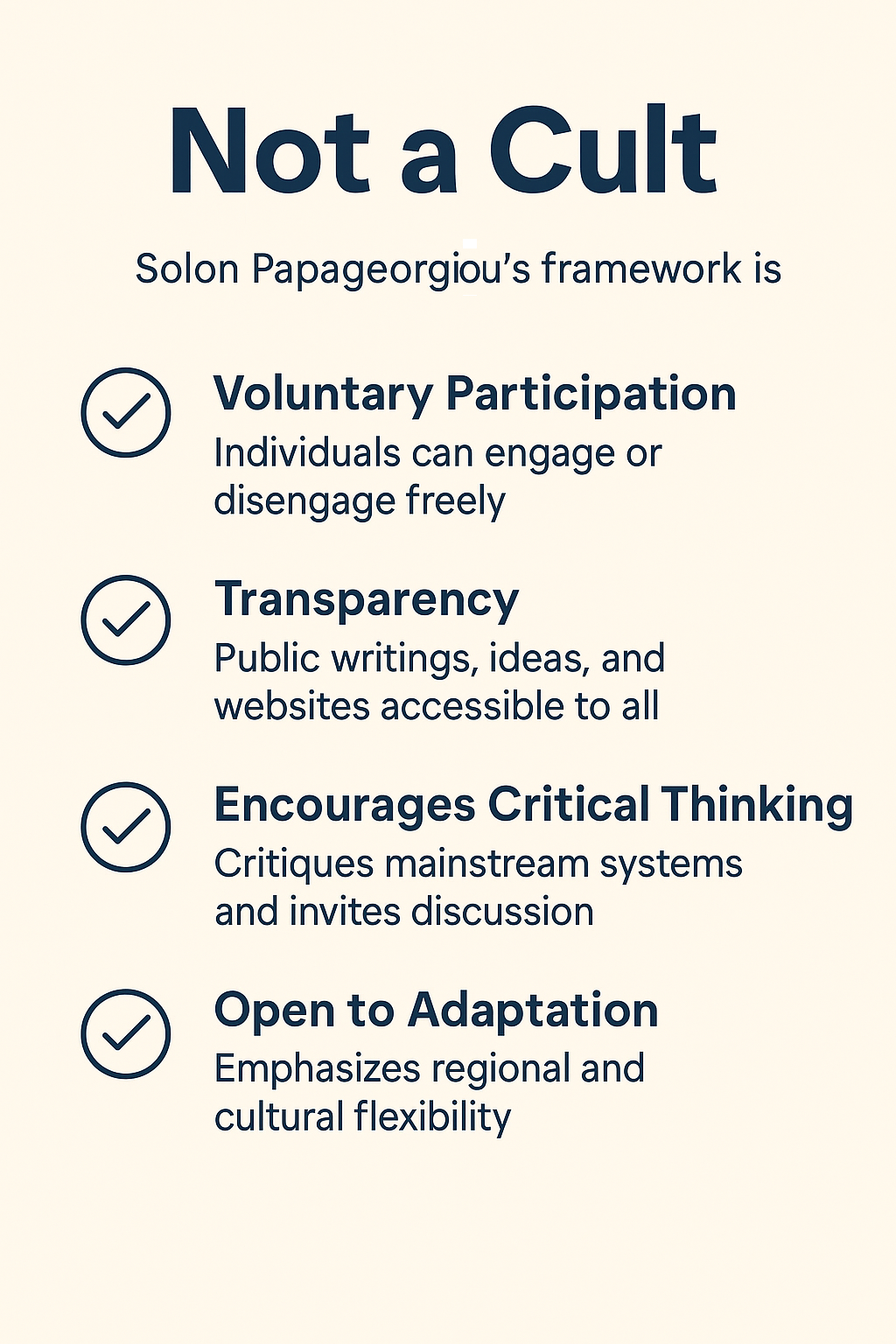
The Hunging Tree If not If not Not a Cult On Value And Failure On Value And Failure On Value And Failure On Value And Failure Secrets!

Comprehensive Step-by-Step Guide to Advancing 100% Physically and Mentally for Athletes


A comprehensive strategy that empowers nations—big and small—to build phenomenal armies, police forces, firefighting services, secret agencies, bodyguards, private investigators, and security personnel + Step-by-Step Guide to Building Phenomenal Forces Using Solon’s Vision | PDF e-book

Tailoring ITSCS + Step-by-Step Guides | PDF e-book

More Tailoring of ITSCS + Step-by-Step Guides | PDF e-book

Even More Tailoring of ITSCS + Step-by-Step Guides | PDF e-book

Click Here to Read the Simplified Summary Click Here to Read the Executive Summary Click Here to Read the Implementation Guides Click Here to Read the Implementation Guides Click Here to Read the Challenging of Psychiatry’s Foundational Assumptions Justice Bio Growth Solon's Stars Solon's Guide: Become a Superhuman ITSCS: The Ultimate System ITSCS: The Ultimate System - Part 2 Essential Herbs, Foods And Tools For Survival And Health Agriculture, Poultry Raising, Fishing, and Livestock Farming Techniques Become multilingual the easy way and in no time! How To Do Meditation: For Professionals, Civilians And All Ages! Build Your Own Home Gym: Affordable, Effective, and Convenient! Apps! Bullet-Resistant Gear, Effective Training And More At Virtually No Or Little Cost And The Implications Of Such A System Solon Under Danger Global Effects Stars-Leaders Superhumans vs Stars-Leaders Current Leaders, Exceptional Individuals & Stars Solon's List & Proofs of the Divine Solon's income and the Sharing of it Cyprus, the 14, the EU, the UN and More Resolution of the Cypriot Problem and Other Global Issues The Guide of How to Raise Superhumans and Star-Leaders Solon's leadership Are You a millionaire? Become a Billionaire! A New Flourishing Era for Psychiatrists and the Psychiatric Big Pharma! Thrive! Unleash Your Full Potential & Beyond! Free For All And Licensing Terms for the Framework The Power of Love Animals Thrive! End to Humanity's Existential Threats! Evolution for All and Everything!

Start a Micro-Utopia in Your Town (10 Steps)

Below is a clear, practical, 10-step guide titled “Start a Micro-Utopia in Your Town”, written for activists, community builders, and local innovators who want an accessible roadmap to launch a real pilot inspired by Solon Papageorgiou’s framework.


Start a Micro-Utopia in Your Town (10 Steps)

A practical field guide for local innovators, activists, NGOs, and community dreamers


1. Define the Vision and Core Principles

Identify the shared values that will anchor your micro-utopia—autonomy, dignity, mutual aid, non-coercion, decentralization, sustainability, or cultural expression.
Write a short vision statement (1–2 pages).
This provides clarity when recruiting participants and prevents mission drift.


2. Gather a Founding Circle (5–20 people)

Recruit a small group who are aligned with the principles.
Prioritize:

  • reliability

  • emotional maturity

  • collaborative communication

  • practical skills

This group will co-design the pilot and perform the early operational tasks.


3. Choose a Location and Scale

Select your starting point. Options include:

  • a shared house

  • a cluster of apartments

  • a community center

  • a rural plot

  • a digital-first network with periodic gatherings

Keep the first unit small (5–30 residents/participants).
Focus on replicability rather than size.


4. Develop a Non-Coercive Governance Model

Establish simple, transparent rules:

  • decisions by consent or supermajority

  • rotating responsibilities

  • full transparency of finances and protocols

  • clear rights and boundaries

Start with minimal structure. Add rules only when needed.


5. Create a Basic Needs Plan

Micro-utopias flourish when participants feel materially secure.
Develop simple strategies for:

  • shared meals

  • housing affordability

  • mutual aid savings

  • emergency assistance

  • time-banking or skill exchange

The goal isn’t perfection—just a predictable and humane baseline.


6. Design Community Rituals and Social Infrastructure

Human bonds require intentional practice.
Choose a few weekly or monthly rituals:

  • shared dinners

  • skill circles

  • check-in meetings

  • conflict-resolution sessions

  • storytelling nights

  • volunteer days

These strengthen trust and reduce conflict over time.


7. Establish Conflict-Resolution and Support Systems

Micro-utopias fail without healthy conflict culture.
Create structures based on:

  • peer mediation

  • active listening

  • autonomy-respecting emotional support

  • no punishment, no coercion

  • restorative processes rather than blame

Train 2–4 members as community mediators.


8. Launch Micro-Economic and Skill-Sharing Activities

Build a lightweight local economy:

  • cooperative ventures

  • shared tools

  • community gardens

  • small workshops

  • remote-work hubs

  • ethical micro-businesses

Prioritize voluntary participation and low barriers to entry.


9. Run a 6–12 Month Pilot Phase

Treat the first year as an experiment.
Track what works and what doesn’t.
Use simple metrics:

  • well-being

  • cohesion

  • resource sufficiency

  • participation

  • governance satisfaction

Hold evaluation meetings every 2–3 months.


10. Document, Share, and Replicate

Once the pilot stabilizes:

  • publish your methods

  • create a simple handbook

  • assist neighboring towns

  • form a regional alliance of micro-utopias

Your town becomes a seed node in a growing global network of community-led futures.


Starter Manual: How to Launch a Micro‑Utopia in Your Town

A 20–40 page practical manual inspired by Solon Papageorgiou’s micro‑utopian framework


Table of Contents

  1. Introduction
  2. What Is a Micro‑Utopia?
  3. Core Principles
  4. The Founding Circle
  5. Choosing a Location and Scale
  6. Governance and Decision‑Making
  7. Basic Needs Framework
  8. Community Rituals and Social Infrastructure
  9. Conflict‑Resolution & Emotional Support
  10. Micro‑Economic and Cooperative Structures
  11. Pilot Phase (6–12 Months)
  12. Evaluation Metrics
  13. Long‑Term Sustainability
  14. Common Pitfalls and How to Avoid Them
  15. Case Examples (Hypothetical)
  16. Replication, Alliances, and Network Growth
  17. Appendices (Tools, Checklists, Templates)

1. Introduction

Micro‑utopias represent a new wave of community‑driven social design, combining autonomy, dignity, mutual aid, and cultural experimentation. Rather than grand idealistic blueprints requiring political revolution, a micro‑utopia is a small‑scale, replicable model that ordinary citizens can build incrementally. This manual guides you through launching a micro‑utopia in your town, based on the principles of Solon Papageorgiou’s framework.


2. What Is a Micro‑Utopia?

A micro‑utopia is a small community or social unit—physical or hybrid‑digital—that intentionally designs its governance, economics, and emotional support systems to maximize well‑being and minimize coercion. It is:

  • Small in scale (5–100 people)
  • Voluntary (no coercive obligations)
  • Adaptive (rules emerge from real needs)
  • Community‑centered (not state‑imposed)
  • Replicable (designed to be copied and adapted)

Micro‑utopias are not communes, religious sects, political cells, or escapist retreats—they are practical laboratories for healthier ways of living.


3. Core Principles

Your micro‑utopia should be anchored in clear principles. The following are recommended:

  • Autonomy: Every participant’s agency and consent are central.
  • Transparency: Governance, finances, and logistics must be visible to all.
  • Mutual Aid: Members support one another voluntarily.
  • Non‑Coercion: No forced treatment, punishment, or social exclusion.
  • Sustainability: Resource use is mindful and regenerative.
  • Pluralism: Diversity of personality, culture, and belief is respected.

Write a concise Charter (1–2 pages) summarizing your group’s interpretation of these principles.


4. The Founding Circle

Your founding circle is the core team that sets the foundations. Recommended size: 5–20 people.

Qualities to recruit for:

  • Reliability
  • Emotional maturity
  • Low drama
  • Practical skills (logistics, budgeting, gardening, mediation)
  • Collaborative mindset

Founding Circle Responsibilities:

  • Draft the Charter
  • Select the location
  • Design governance structure
  • Establish conflict‑resolution framework
  • Plan the pilot phase
  • Maintain financial transparency

Start with people who share values—not necessarily close friends.


5. Choosing a Location and Scale

Possible starting formats:

  • Shared house
  • Cluster of apartments
  • Rural land plot
  • Underused municipal building
  • Community center with hybrid membership
  • Hybrid digital‑physical community

Guidelines:

  • Start small (5–30 participants)
  • Choose a location that minimizes cost and maximizes stability
  • Design for expansion only after year one
  • Prioritize safety, accessibility, and logistical realism

A micro‑utopia is not defined by geography but by design, but physical proximity accelerates cohesion.


6. Governance & Decision‑Making

Governance should be simple, transparent, and scalable.

Recommended structure:

  • Consent‑based decisions for everyday matters
  • Supermajority (70–80%) for structural changes
  • Rotating responsibilities (logistics, finance, facilitation)
  • Monthly Assemblies for review
  • Open documentation accessible to all members

Avoid overly complex constitutions.

Rules should emerge from real problems, not hypothetical ones.


7. Basic Needs Framework

A micro‑utopia thrives when participants feel secure. Ensure predictable access to:

  • Affordable housing (shared or subsidized)
  • Food systems (meal rotation, communal cooking, gardens)
  • Mutual‑aid emergency fund
  • Shared tools and equipment
  • Basic long‑term planning (transportation, healthcare navigation)

This is not about achieving perfection—it’s about removing chronic stress.


8. Community Rituals & Social Infrastructure

Social cohesion is built through intentional rituals.

Recommended practices:

  • Weekly shared meal
  • Biweekly check‑in circle
  • Monthly conflict‑prevention workshop
  • Skill‑sharing gatherings
  • Cultural nights (music, storytelling, film)
  • Seasonal celebrations

Rituals create psychological safety and belonging.


9. Conflict‑Resolution & Emotional Support

A community without conflict‑resolution structures eventually collapses.

Guiding principles:

  • No punishment or coercion
  • Focus on understanding, not blame
  • Restore relationships where possible

Key tools:

  1. Mediation: Two trained peers facilitate dialogue.
  2. Restorative circles: Community‑wide repair process.
  3. Cooling‑off protocols: Temporary space before discussion.
  4. Emotional support teams: Trained volunteers to listen, not diagnose.

Micro‑utopias prioritize dignity in conflict.


10. Micro‑Economic & Cooperative Structures

Economic life should be flexible and inclusive.

Possible micro‑economic models:

  • Cooperative gardening
  • Shared workshops
  • Remote‑work hubs
  • Micro‑business incubators
  • Time‑banking systems
  • Tool libraries
  • Co‑ops (food, craft, energy)

Avoid rigid collectivism. Participation must always be voluntary.


11. Pilot Phase (6–12 Months)

Treat your first year as an experiment.

Pilot objectives:

  • Test governance
  • Evaluate rituals
  • Track well‑being
  • Monitor resource sufficiency
  • Resolve early conflicts

Quarterly reviews should assess:

  • What is working?
  • What causes friction?
  • Which rules need updating?
  • How well the Charter holds up?

The pilot phase determines long‑term viability.


12. Evaluation Metrics

Use simple indicators to track progress.

Well‑Being Indicators:

  • Self‑reported satisfaction
  • Psychological safety
  • Sense of belonging

Social Indicators:

  • Participation rates
  • Conflict frequency
  • Resolution success

Economic Indicators:

  • Resource sufficiency
  • Financial stability
  • Skill utilization

Governance Indicators:

  • Transparency levels
  • Rule compliance
  • Member trust

Regular evaluation prevents entropy.


13. Long‑Term Sustainability

For long‑term success:

  • Avoid burnout: distribute tasks
  • Build external partnerships (NGOs, local councils)
  • Train future facilitators and mediators
  • Diversify income streams
  • Maintain open communication culture

A sustainable micro‑utopia evolves with its members.


14. Common Pitfalls and How to Avoid Them

Pitfall 1: Over‑idealism

Solution: Start small, adapt fast.

Pitfall 2: Leadership vacuum

Solution: Rotate facilitation.

Pitfall 3: Emotional burnout

Solution: Clear boundaries + shared tasks.

Pitfall 4: Financial opacity

Solution: Transparent shared ledger.

Pitfall 5: Over‑regulation

Solution: Add rules only when necessary.


15. Case Examples (Hypothetical)

Case A: Urban Micro‑Utopia in a Shared Apartment Cluster

  • 12 members
  • Weekly meals + rotating support roles
  • Community garden on rooftop

Case B: Rural Eco‑Micro‑Utopia

  • 25 members
  • Regenerative agriculture
  • Solar microgrid

Case C: Hybrid Digital‑Physical Network

  • 40 members across a city
  • Weekly gatherings in a rented hall

16. Replication, Alliances & Network Growth

Micro‑utopias grow through modular replication.

Steps to expand:

  • Share your Charter
  • Mentor new groups
  • Create regional federations
  • Host annual gatherings

Network effects amplify resilience.


17. Appendices


A. Founding Circle Checklist

Use this checklist to ensure your founding group is ready to launch a micro-utopia:

People & Values

  •  Recruit 5–20 committed participants

  •  Shared understanding of core principles (autonomy, transparency, mutual aid, non-coercion)

  •  Diversity of skills and backgrounds

  •  Commitment to non-coercive culture

  •  Availability for weekly or biweekly meetings

Practical Skills Represented

  •  Logistics/operations

  •  Finance/budgeting

  •  Mediation/communication

  •  Gardening/food systems (optional)

  •  Tech or documentation skills

Preparation Tasks Completed

  •  Draft community Charter

  •  Initial governance structure agreed

  •  Conflict-resolution protocol drafted

  •  Basic needs plan outlined

  •  Location options discussed

  •  Pilot phase timeline drafted


B. Sample Charter Template

Purpose: Define the micro-utopia’s mission and shared values.

Core Principles:

  1. Autonomy and informed consent

  2. Transparency in all community functions

  3. Voluntary participation and contribution

  4. Commitment to mutual aid

  5. Respect for diversity and pluralism

  6. Minimal and adaptive governance

Decision-Making:

  • Everyday matters: consensus or consent

  • Structural changes: 70–80% supermajority

  • Documentation: All decisions recorded and publicly accessible

Membership:

  • Voluntary; members may exit at any time

  • No coercive removal; restorative approaches preferred

Conflict-Resolution:

  • Mediation first, restorative circles as needed

  • No punishment or diagnostics

Amendment Process:

  • Proposed by any member

  • Discussed in Assembly

  • Approved by supermajority


C. Conflict‑Resolution Protocol

A simple, non-coercive system for managing tensions:

  1. Direct Dialogue

  • Encourage respectful conversation

  • Use “I statements” and avoid blame

  1. Mediation

  • Facilitated by two trained members

  • Focus on clarity, understanding, and emotional safety

  • Not for assigning guilt

  1. Restorative Circle

  • For community-wide impact

  • Includes affected members + 1 facilitator

  • Goal: repair harm, clarify commitments, restore trust

  1. Cooling-Off Space

  • Optional reflection period before next step

  1. Follow-Up

  • Check-ins two weeks after resolution

  • Document insights to improve community culture


D. Governance Meeting Agenda

Recommended structure for monthly or biweekly Assemblies:

  1. Opening (5 min)

    • Quick check-in

    • Review meeting agreements (respect, listening)

  2. Updates (10 min)

    • Logistics

    • Finance

    • New members

  3. Review Past Actions (10 min)

    • What was promised in last meeting?

    • Completed? Pending?

  4. Discussion Items (20–40 min)

    • Governance proposals

    • Community needs

    • Resource issues

  5. Conflict-Prevention/Mediation Requests (Optional)

    • Brief summaries; not full mediation

  6. Decisions (15 min)

    • Consent or supermajority votes

    • Document in shared ledger

  7. Closing Round (5 min)

    • Final reflections


E. Financial Transparency Tools

Key tools to maintain trust and accountability:

1. Shared Ledger

  • Tracks income, expenses, balances, and notes

  • Publicly accessible

2. Budget Forecasting Template

  • Monthly expected expenses

  • Emergency fund targets

  • Voluntary contributions

  • Projected surplus/deficit

3. Receipt Archive

  • Digital folder accessible to all

  • Upload receipts within 48 hours

4. Financial Roles

  • Treasurer (rotating every 3–6 months)

  • Budget reviewer

  • Annual audit circle (3 randomly chosen members)

5. Transparency Principles

  • No hidden transactions

  • No private financial authority

  • All members can question entries

  • Ledger reviewed monthly


F. Templates & Worksheets

A set of practical tools for implementation:

1. Member Intake Form

  • Name, contact, skills, interests

  • Agreement to Charter principles

2. Pilot Phase Checklist

  • Governance trial period tasks

  • Social rituals schedule

  • Resource sufficiency monitoring

3. Conflict-Resolution Log

  • Incident description

  • Steps taken (dialogue, mediation, circle)

  • Follow-up notes

4. Community Meeting Notes Template

  • Agenda items

  • Decisions and responsible persons

  • Deadlines

5. Financial Tracking Sheet

  • Columns for income, expense, purpose, responsible member

  • Monthly totals and variance analysis

6. Feedback & Evaluation Form

  • Well-being rating

  • Participation satisfaction

  • Suggestions for improvement

Who's new

  • Barrettfig
  • KaresPaync
  • Leoia
  • RandyMoile
  • Shraunweb
  • JamesPaync
  • Brianbet
  • PatrickTar
  • JaceKaL
  • Adriankax
  • Matthewtog
  • VictorFah
  • CharlesFah
  • LanguageExplor…
  • tgkoknae
  • LonnieMup
  • PamelaRor
  • AllenOpign
  • FreddieTaM
  • ZarChita
  • AlfonzoLem
  • JamesBak
  • otaletyepu
  • MitziHox
  • Gabrielcof
  • Eugenedenda
  • ChatGPTTuP Onl…
  • Ellenfix
  • Shrauncik
  • JamesPreen
  • Ronaldjouck
  • RonaldDeedy
  • Danielkaf
  • Luizacoipt
  • Monica fem
  • Kirstenecora
  • Travismor
  • Annikacoirm
  • CharlesSab
  • DennisCow
  • Marievelia
  • Michaelcew
  • JulieAlame
  • Andrewwak
  • RobertLoake
  • GeraldLix
  • NathanEstab
  • Merlin AI fub

Made by Solon with -`♡´-

About This Website

Medical Safe Disclaimer

Author Of This Website